Pete Marino
Kay ScarpettaPete Marino is the novel’s bruised investigative force: a former police officer who has lost rank, authority, possessions, and much of his former identity, yet continues to push the investigation forward through stubborn observation and dangerous direct action. His significance lies in the contradiction he embodies. He is trying to reconstruct a disciplined life after alcohol and professional humiliation, but the old appetite for control still survives in his anger, his language, and his willingness to put his body in harm’s way.
Identity and Background
Pete Marino lives alone in a one-room flat in Harlem, so close to Manna’s Soul Food that the smell of fried chicken and roasted crab cakes continually reaches him. The proximity is a daily test because he has renounced good food and alcohol while remaining intensely hungry for what he is not allowed to have. His dinner is correspondingly austere: a whole-wheat sandwich spread with deli turkey and Nathan’s Coney Island mustard, a paper plate, and a Sharp’s alcohol-free beer consumed in only a few swallows.
His reduced circumstances are visible in the objects he has surrendered. Since fleeing Charleston, he has lost fifty pounds and several sides of his personality. He sold boxes of motorcycle clothing, including an impressive collection of Harley-Davidson leather, at a bazaar on 116th Street and exchanged them for three suits, a blazer, two pairs of dress shoes, and shirts and ties, most of them discounted and made in China. He has sold both his motorcycle and pickup truck because he has nowhere to park them, and he no longer wears his diamond earring. The small hole remaining in his right earlobe functions as an almost emblematic trace of the stripped-down life he is trying to accept.
His body also records change. The former smooth, billiard-ball-like scalp is now ringed by gray hair growing into an incomplete silver aureole. The image combines loss and persistence: Marino is no longer the man he was, but neither is he entirely remade. His therapist Nancy has taught him to practice self-control in daily dealings with other people, regardless of their faults or of what they may or may not deserve. He has even promised himself not to look for a woman until he is ready, treating restraint as a practical discipline rather than a sentimental resolution.
Life and Plot Trajectory
Marino’s professional history explains why his private decline feels like a civic and masculine catastrophe to him. After resigning from the police in Richmond, he first worked as a private investigator for Lucy Farinelli and then as a homicide detective for Kay Scarpetta. The transition cost him more than a title. He lost the power associated with law enforcement and, with it, much of his self-respect. He can no longer arrest anyone, issue a parking ticket, or order a vehicle towed. What remains is the ability to intervene forcefully in a situation and use muscular language, a diminished authority that he experiences as an assault on his identity.
Marino recognizes that his conduct has not always been right. He understands that his attempt to prove to Kay Scarpetta that he still possessed power was also an attempt to prove it to himself and to put his life back in order; he does not present that motive as an excuse. This self-knowledge is important because his recovery is not framed as a clean moral conversion. He remains ashamed, defensive, and capable of self-justification, but he is increasingly able to distinguish explanation from absolution.
The investigation gives this diminished man a field in which his remaining abilities matter. He tries endlessly to search Gotham Gotcha, but the site reveals little beyond its enormous audience and its capacity to turn the worst period of his life into consumable gossip. When Mike Morales phones him, Marino answers directly and receives Morales’s slang-heavy report about a data hunt. The exchange places Marino back inside an investigative network, even though his life outside that network has become spare and unstable.
His persistence repeatedly carries him toward mistaken conclusions and then back toward evidence. After learning that an assailant may have staged details of an attack, he insists that no perfect crime exists and that the offender must have made a mistake. He even attributes to Kay Scarpetta a repeated belief that she could commit such a crime perfectly, although she cannot remember ever saying it and regards the idea as both foolish and repellent. Marino’s confidence therefore has a double edge: it supplies the investigative principle that keeps him searching, while the surrounding conversation reveals how easily language and identity can be manipulated.
Key Actions and Objectives
Marino’s body often acts before his reflection catches up. When Kay Scarpetta picks up a pair of forceps, he stares at them with an anxious expression, says he does not need them, and offers to do the task himself. The moment exposes a fear that his abrasive manner normally conceals. His bravado is not the absence of vulnerability; it is one of the methods by which vulnerability is held at a distance.
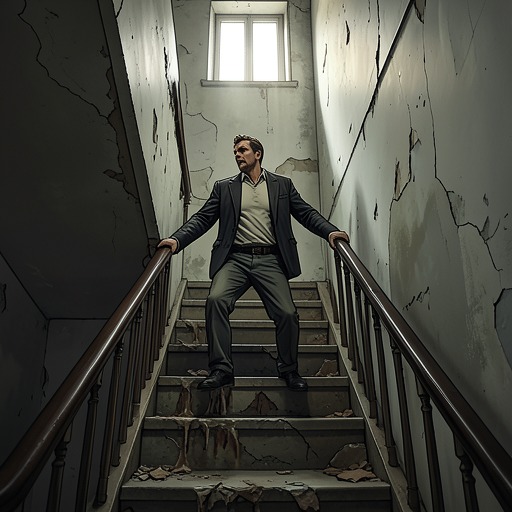
That bodily contradiction becomes more dangerous on the roof. Marino climbs a narrow ladder while holding a .40 Glock, convinced that the ladder will tear loose from the old brick building and send him falling backward to his death. He has only recently developed a fear of heights, after leaving Charleston. Benton Wesley connects the fear with depression and nervousness and recommends a treatment involving D-cycloserine, while Nancy calls it an unconscious conflict and links its persistence to alcohol. Marino, however, has a more immediate explanation: the ladder is genuinely narrow and attached by only a few screws.
At the roof, he reaches the practical limit of his fear and finds Mike Morales aiming a revolver while lying prone like a sniper. For a moment neither man moves. Morales then holsters the weapon and angrily calls Marino a stupid ox; Marino answers with equal hostility because he had thought Morales was the serial killer. The encounter captures Marino’s investigative method in miniature: courage mixed with misrecognition, physical risk followed by verbal aggression, and the possibility that the colleague being confronted may also be the danger being hunted.
Even while handling such threats, Marino continues to pursue the digital and financial trail around Gotham Gotcha. The discovery that an email written from the scarpetta612 account was composed at 8:19 the previous evening but never sent becomes decisive because it means neither Terri Bridges nor Oscar Bane could have written it. Marino immediately recognizes the implication: someone produced the message while police crowded the scene, at a time when Terri’s body was probably already in the morgue. His response shows the value of his instinctive suspicion; he does not treat digital evidence as separate from the physical crime scene.
He also helps connect the investigation to the offshore structure behind Gotham Gotcha. The anonymous writer’s provider account is held by an LLC with an Isle of Man address, and the apartment above Terri Bridges’s is rented in the name of Cesare Ingicco, an Italian financier whose company is based there. Marino reasons that Ingicco probably does not live in the apartment and that another person may work there. He argues for a search warrant and immediate action, emphasizing that Eva Peebles had worked indirectly for Ingicco and probably communicated with him internationally by telephone. The trail remains uncertain, but Marino understands that anonymity is being sustained not only by false names and hidden devices but also by jurisdiction, corporate structures, and paid intermediaries.
Relationships and Conflict
Marino’s relationship with Kay Scarpetta is shaped by loyalty, resentment, and the need for recognition. He wants to remain useful to her, but usefulness is entangled with his need to recover an authority he believes he lost. His earlier attempt to prove his potency to Scarpetta was therefore both professional and deeply personal. The relationship is protective, but it also exposes how easily professional dependence can become a stage on which Marino performs wounded masculinity.
His connection with Benton Wesley is more restrained and functional. Benton offers clinical interpretations of Marino’s fear and remains part of the professional structure that helps translate Marino’s symptoms into possible treatment. Marino’s exchanges with Mike Morales are harsher. Morales’s slow, lazy manner and Marino’s blunt replies create an abrasive working rhythm, yet the two remain connected by the investigation. On the roof, their mutual suspicion nearly turns collaboration into confrontation, but the encounter also demonstrates that Marino is willing to test danger directly rather than remain safely behind speculation.
Marino’s recovery is likewise mediated by Nancy, whose counsel challenges his preferred explanations. He remembers her saying that alcohol had made him push people away, while he insists that he has gone a full month without drinking and that the distancing was his own doing. The argument is revealing precisely because he refuses to surrender responsibility to drink. He may still be defensive, but he is beginning to see that sobriety does not automatically repair the relationships damaged during addiction.
A later greeting from Marino to Scarpetta condenses the history between them. A dark-blue Impala waits outside the hospital, and Scarpetta recognizes Marino by his shearling-lined leather jacket. He takes her work case from Benton and says that he has brought coffee for them, two cups waiting on the back seat. After everything that has happened and after so much time apart, this practical gesture becomes his chosen language of return: not an apology or declaration, but assistance, presence, and coffee brought into the darkness.
Change and Narrative Role
Marino’s central change is from unexamined force toward difficult self-observation. He has relinquished alcohol, lost weight, sold the possessions that supported his old self-image, and accepted a life with fewer comforts and less mobility. None of these changes makes him serene. Hunger, fear, shame, and anger remain active. What changes is his capacity to recognize them without pretending they belong entirely to someone else.
His physical reactions often tell the truth before his explanations do. Anxiety appears in his eyes when he sees the forceps; terror becomes sweat, a pounding heart, and trembling knees on the ladder; anger returns when fear has to be named. The body is not merely a damaged instrument that obstructs the investigation. It is the medium through which Marino encounters the consequences of his past and the limits of his present control.
As an investigator, he occupies an unstable position between insider and outsider. He knows police procedure, homicide work, and the habits of investigators, but he no longer possesses the official powers that once defined him. That marginality makes him both frustrated and valuable. He can move with the urgency of a law-enforcement officer while feeling the humiliation of someone who has been expelled from full authority. His insistence that every perfect crime contains a mistake becomes a professional creed and a personal hope: if the offender has left a flaw, then Marino may still be capable of finding it.
The novel also uses Marino to expose the knowledge gaps produced by digital anonymity and manipulated identities. He searches a gossip platform that has publicly consumed his suffering, follows a data trail that leads through offshore companies, and confronts evidence capable of excluding both Terri Bridges and Oscar Bane from authorship of a crucial email. His errors do not cancel his value; they make the investigation’s suspense depend on correction rather than omniscience. Marino is most effective when his damaged instincts are forced into contact with verifiable evidence.
By the time he returns with coffee, Marino has not recovered the old version of himself. The leather jacket remains, but the motorcycle and truck are gone; the aggressive investigator remains, but sobriety and fear have made his self-image less secure. His ending position is therefore provisional rather than triumphant. He continues to work, to risk himself, and to seek the mistake hidden inside an apparently perfect crime, while learning that rebuilding a life requires more than reclaiming power. It requires accepting dependence, limitation, and responsibility without surrendering the stubborn competence that still makes him indispensable.